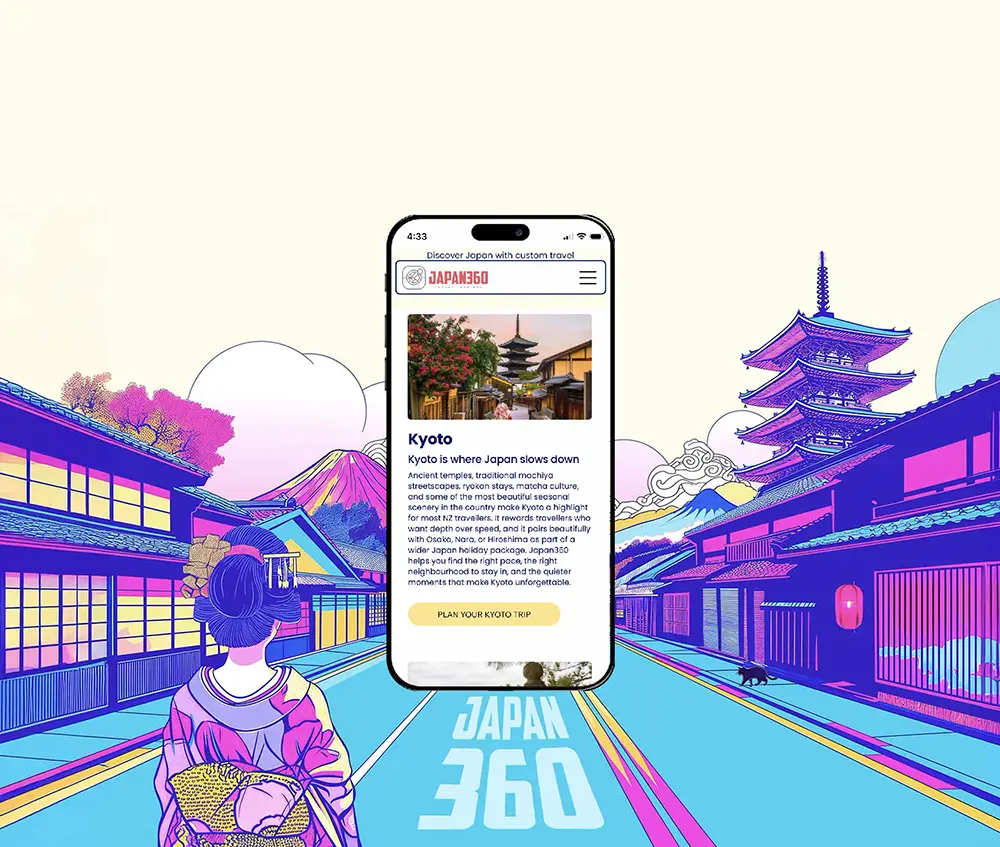

A strong brand. A specialist product. Zero NZ rankings. Here is what we found and what we fixed.
The diagnostic: what Sphynx 2.0 found.
Before touching a single page, we ran Sphynx 2.0 on the NZ Japan travel market. The diagnostic confirmed what we suspected: the competitive landscape was far weaker than it appeared.
The operators ranking in NZ Google search were primarily global tour companies and Australian operators. None of them were NZ-based Japan specialists. The specific searches being made by NZ travellers looking for local, specialist, bespoke Japan experiences were almost entirely uncontested.
None of them were speaking directly to the audience Japan360 was built to serve.
The gap was real. The position was genuinely available. The diagnostic confirmed the battle was worth fighting.
What was wrong with the site.
The site was beautifully designed and the brand was strong and full of energy, but the the page structure was not aligned with how NZ customers actually searched for Japan travel.
What we added.
Site health moved from 79% to 99%. Errors from 3 to 1. Warnings from 7 to 0.
New pages were built targeting the specific search intents the diagnostic identified, each with the right architecture, the right copy, and the right schema markup.The primary landing page was rebuilt from scratch with Chika's story, the value propositions, a full 13-question FAQ, and the case study from the school tour that started the business.
What happened within 24 hours.
Position 1 on the primary search term, within 24 hours of implementation. Up from unranked.
Position 1 on multiple other Japan travel terms targeted by the new page structure. Previously unranked.
Overall NZ search visibility up nearly 10 percentage points in 24 hours.
Featured in Google AI Overview as the first named Japan travel provider for multiple relevant searches, appearing alongside major international operators in a cold incognito search with no browsing history.
The results were fast because the gap was genuinely open and the architecture was precisely built to take it. There was no guesswork. The diagnostic had already confirmed which positions were available and what the site needed to say to rank for them.
→ Read the full Japan360 case study
Why speed matters in SEO.
The competitive landscape shifts. A gap that is open today may not be open in six months. Once a competitor realises the opportunity exists and builds a properly structured page to target it, the advantage is harder to establish.
Japan360 went from invisible to position 1 before any of the existing competitors noticed the gap. By the time they do, Japan360 will have months of ranking history, review accumulation, and authority building behind it.
This is what the Kyttn diagnostic model is designed to produce. Find the gap fast. Build precisely. Move before the competition notices.
→ How the five-phase system works
Japan360 had something genuinely valuable and genuinely invisible. The diagnostic found the gap. The architecture took it. The results came within 24 hours.
If your business has something real and the right people are not finding it, the gap may already be there.
→ Find out what is blocking your rankings