Pacific Cycle Tours. This is what happens when a great business gets found.

Pacific Cycle Tours. This is what happens when a great business gets found.

Phases 1 through 3 / International / Travel and tourism.

Some businesses have to invent their story. This one had thirty years of it. Pacific Cycle Tours, family-run and South Island born, has been Brett and Judy's since 2018: multi-day e-bike journeys through the mountains, valleys and lakes, sixty-three Google reviews, a perfect five-star rating. The product was never the problem. Being found was.

A grid of mobile webpages build by Kyttn for Pacific Cycle Tours

Phases 1 through 3 / International / Travel and tourism.

Some businesses have to invent their story. This one had thirty years of it. Pacific Cycle Tours, family-run and South Island born, has been Brett and Judy's since 2018: multi-day e-bike journeys through the mountains, valleys and lakes, sixty-three Google reviews, a perfect five-star rating. The product was never the problem. Being found was.

A grid of mobile webpages build by Kyttn for Pacific Cycle Tours

The numbers.

The numbers.

What the system produced.

$

0-18

0-18

measurable enquiries in month one after launch

measurable enquiries in month one after launch

#1

#1

Page 2 → 1 on every Australian money search

Page 2 → 1 on every Australian money search

90%

90%

 AI answer visibility from 40%

 AI answer visibility from 40%

81%

organic sessions up in the first 28 days

50%

50%

of website enquirers went on to book

#2

#2

#3 → #2 cycle tour operator by search visibility

#3 → #2 cycle tour operator by search visibility

25

25

guests booked in the first month

guests booked in the first month

Pacific Cycle Tours Web design by Kyttn on tablet and mobile

Their words.

Their words.

"From the moment our new website launched, the proof was in the enquiries. More quality hits, more enquiries that converted to bookings, and it felt like the increase was almost immediate. One of the best investments we have made to date."

Brett, from Pacific Cycle Tours

The starting point

The starting point

Brett and Judy had built the hard part. Three decades of touring heritage, a five-star product, and a market of travellers actively searching for exactly what they sell. Sphynx 2.0 ran on that market in July, and the first thing it found was good news: the demand was real, measurable, and already out there.

The second thing it found was where that demand was going. The Australian searches that actually sell tours were landing on page two of Google, positions 15 to 20. And page two is the graveyard of the internet. Travellers were looking for a business exactly like this one, and finding somebody else first.

AI assistants told the same story from another angle. Pacific was already the first name recommended in Canada, proof the reputation carries, but not yet in Australia and the United States, the two markets that matter most. Across a 22-question test of realistic buyer questions, Pacific appeared in 40 percent of the answers. All the raw material was there. It just wasn't standing where the buyers were looking.

And like most operators in the industry, they'd been making marketing decisions without instruments, because nobody had ever wired the measurement in. So that became the first build decision: industry-leading tracking on every form and every phone path, so from day one everyone could see exactly where, when and how customers arrive.

From there, Sphynx mapped the way up: which searches to move onto page one, what it would take for the AI assistants in Australia and the US to start naming Pacific, and the 46 pages the site needed to do it.

Brett and Judy had built the hard part. Three decades of touring heritage, a five-star product, and a market of travellers actively searching for exactly what they sell. Sphynx 2.0 ran on that market in July, and the first thing it found was good news: the demand was real, measurable, and already out there.

The second thing it found was where that demand was going. The Australian searches that actually sell tours were landing on page two of Google, positions 15 to 20. And page two is the graveyard of the internet. Travellers were looking for a business exactly like this one, and finding somebody else first.

AI assistants told the same story from another angle. Pacific was already the first name recommended in Canada, proof the reputation carries, but not yet in Australia and the United States, the two markets that matter most. Across a 22-question test of realistic buyer questions, Pacific appeared in 40 percent of the answers. All the raw material was there. It just wasn't standing where the buyers were looking.

And like most operators in the industry, they'd been making marketing decisions without instruments, because nobody had ever wired the measurement in. So that became the first build decision: industry-leading tracking on every form and every phone path, so from day one everyone could see exactly where, when and how customers arrive.

From there, Sphynx mapped the way up: which searches to move onto page one, what it would take for the AI assistants in Australia and the US to start naming Pacific, and the 46 pages the site needed to do it.

Brett and Judy had built the hard part. Three decades of touring heritage, a five-star product, and a market of travellers actively searching for exactly what they sell. Sphynx 2.0 ran on that market in July, and the first thing it found was good news: the demand was real, measurable, and already out there.

The second thing it found was where that demand was going. The Australian searches that actually sell tours were landing on page two of Google, positions 15 to 20. And page two is the graveyard of the internet. Travellers were looking for a business exactly like this one, and finding somebody else first.

AI assistants told the same story from another angle. Pacific was already the first name recommended in Canada, proof the reputation carries, but not yet in Australia and the United States, the two markets that matter most. Across a 22-question test of realistic buyer questions, Pacific appeared in 40 percent of the answers. All the raw material was there. It just wasn't standing where the buyers were looking.

And like most operators in the industry, they'd been making marketing decisions without instruments, because nobody had ever wired the measurement in. So that became the first build decision: industry-leading tracking on every form and every phone path, so from day one everyone could see exactly where, when and how customers arrive.

From there, Sphynx mapped the way up: which searches to move onto page one, what it would take for the AI assistants in Australia and the US to start naming Pacific, and the 46 pages the site needed to do it.

The brand.

The brand.

Built to match the people.

Read Pacific's Google reviews and a pattern appears long before the scenery gets mentioned: Brett and Judy themselves. Sixty-three five-star reviews full of their warmth, their care, their straight answers. That is the brand. The job was making sure the website carried the same DNA, so the person who enquires meets the same people the reviews promised, end to end. And it pays twice now: AI search skims past sameness and cites a point of difference, so sounding exactly like yourselves is not just charm, it is visibility.

So before anything was designed, we collected the company. A founder questionnaire, the reviews, three decades of customer knowledge. The redesign, the rebrand and the refocus were built from that, with every paragraph on every page written to carry Brett and Judy's particular charm, locked facts and all, so it reads like them talking. Because it is.

The design followed the customer. These are travellers 55 and over, riding for the scenery rather than the adrenaline, many finally taking the New Zealand trip they have promised themselves for years. So the imagery runs full-bleed, the landscapes are the argument and nothing competes with them. The palette was lifted straight from the track: the lilac of Mackenzie lupins, tussock gone gold in the late light, alpine fern under the West Coast canopy, the milky blue of glacier-fed lakes. Muted on purpose, every colour something you see from the saddle, chosen to frame the photography instead of fighting it.

And because the audience is 55 plus, accessibility was treated as conversion work, not compliance. Large, easy-reading type on every device, generous contrast, booking paths that never make anyone hunt. A site their customers find beautiful and their customers' eyes find easy. Same thing, done properly.

Brand colours for Pacific Cycle Tours were chosen to work with their scenic imagery

What we built.

What we built.

Six weeks, July to launch day.

A complete rebuild: 46 pages designed from more than 14,000 keywords of research, so every page answers one search a real traveller makes. Tour pages that sell. A booking form on every path. And a layer of trail guides, Lake Dunstan, the Otago Central Rail Trail, the West Coast, built to be the honest answer wherever the question gets asked. Doors into the website, not brochures inside it.

The diagnostic and the owners' own knowledge put the customer in focus: riders 55 and over, there for the scenery rather than the adrenaline. So the palette went muted, colours lifted straight from the saddle, tussock gold, glacial blue, deep sound, chosen to frame the photography instead of fighting it.

A voice system built from the DNA of the company and true and bespoke to them, warm storytelling and dead straight, with locked facts, applied to every page and every ad, so it reads like Brett and Judy talking, because it is.

The measurement is total. Twelve tracked forms, analytics wired end to end, and a three-way reconciliation between the form inbox, the analytics and the client's own booking book, so every enquiry is counted and every booking attributable.

The advertising was rebuilt from scratch. Google Ads on exact-match discipline with a published forecast to test against. Facebook rebuilt with the right countries, the right placements, and measurable lead events for the first time.

Launch took one morning, 18 August, with zero downtime and a redirect architecture that carried three years of ranking equity across. Then everything was handed back. Their site, their accounts, their data.

Month 01.

Month 01.

The plan targeted 17 to 18 enquiries a month by month twelve. Month one produced 18.

Half of the people who enquired through the website went on to book. The plan had assumed 25 to 35 percent. Nine parties booked, around 25 guests, roughly 15 of them onto guided tours, about a third of the entire annual guided growth goal, in the first month.

The Australian money searches moved from page two to page one, most into the top three. The Lake Dunstan guide went straight to number one on a search made 1,300 times a month, and it's the source Google's own AI answer quotes. Across the 22-question buyer test, AI visibility went from 40 percent to 90 percent, with the site cited in Google's AI answers for 20 tracked searches across four countries, including the Australian and US answers that barely mentioned Pacific in July. One month after launch, Pacific had moved from third to second cycle tour operator in the country on independent visibility tracking, the biggest climber in the field.

A layout of a long webpage designed by Kyttn for Pacific Cycle Tours

Working as predicted.

Working as predicted.

The parts we're proudest of.

The first Google Ads conversion paid for the month's ad spend about five times over, and tour-intent clicks converted at exactly the rate the model predicted. The advertising strategy evolved with the build. Like most tourism businesses, Pacific had been investing in social advertising, working to generate demand. The diagnostic showed thousands of travellers already searching, already in the buying mindset, so the smarter dollar moved to capturing demand that exists: reaching people at the exact moment they're looking.

Tour-intent clicks were converting at exactly what the model predicted. The advertising strategy evolved with the build. Like most tourism businesses, Pacific had been investing in social advertising, working to generate demand. The diagnostic showed thousands of travellers already searching, already in the buying mindset, so the smarter dollar moved to capturing demand that exists: reaching people at the exact moment they're looking. The shift was made the honest way, the rebuilt social campaigns got a fair, measured test first, and when the numbers favoured searching travellers over scrolling ones, the recommendation went the only direction the data allowed. The client now spends less a day overall than before we arrived. A consultancy that moves your money to where it works, and hands some of it back.

Every month, the report plots what actually happened against the forecast band, in the open, so the promise gets tested in public. Month one's dot landed inside the year-end target band. Every spend recommendation ships with the number that would reverse it. And once a search is won free, we stop paying for it.

Their words.

Their words.

"The new site is definitely doing great things. Our enquiries are absolutely on the up and bookings are coming through. So happy."

Judy, from Pacific Cycle Tours
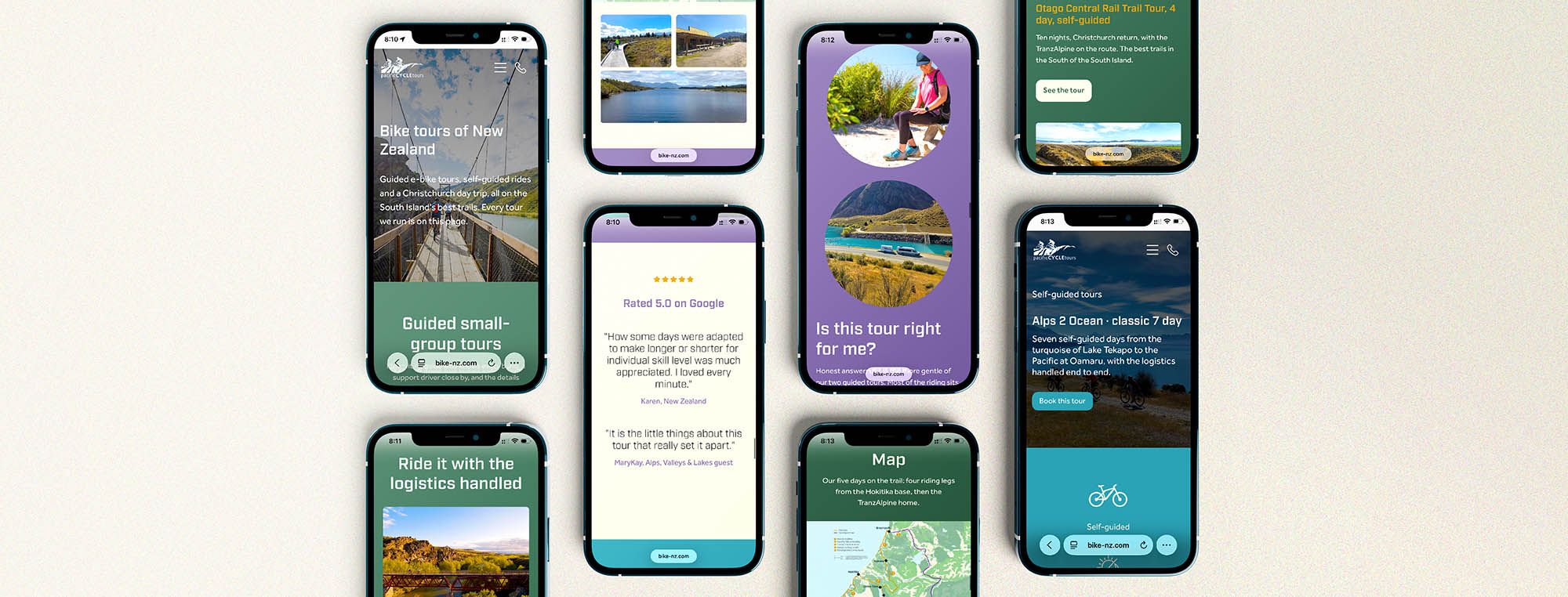
A grid of mobile phones all GEO and ai enabled

Kyttn

Let's talk.

By submitting, you agree to our Terms and Privacy Policy.

© 2026 Kyttn

Your business works. Your website should too.

The first conversation is free. If there's a real opportunity, we run Sphynx 2.0 on your market: NZD $489, about a week, and you keep the findings either way. If you engage further, it comes off your first invoice.

No obligation. No pitch deck.

Just a straight conversation about where your business is and where it could be.

Kyttn

Let's talk.

By submitting, you agree to our Terms and Privacy Policy.

Your business works. Your website should too.

The first conversation is free. If there's a real opportunity, we run Sphynx 2.0 on your market: NZD $489, about a week, and you keep the findings either way. If you engage further, it comes off your first invoice.

No obligation. No pitch deck.

Just a straight conversation about where your business is and where it could be.

Kyttn

Let's talk.

By submitting, you agree to our Terms and Privacy Policy.

© 2026 Kyttn

Your business works. Your website should too.

The first conversation is free. If there's a real opportunity, we run Sphynx 2.0 on your market: NZD $489, about a week, and you keep the findings either way. If you engage further, it comes off your first invoice.

No obligation. No pitch deck.

Just a straight conversation about where your business is and where it could be.