How to get your business recommended by AI.

How to get your business recommended by AI.

How to get your business recommended by AI.

When someone asks ChatGPT, Gemini or Google's AI to recommend a business like yours, a name comes back. This page explains how that name gets chosen, what it is worth when it is yours, and how to become the answer. Built on measured results from real NZ businesses.

When someone asks ChatGPT, Gemini or Google's AI to recommend a business like yours, a name comes back. This page explains how that name gets chosen, what it is worth when it is yours, and how to become the answer. Built on measured results from real NZ businesses.

When someone asks ChatGPT, Gemini or Google's AI to recommend a business like yours, a name comes back. This page explains how that name gets chosen, what it is worth when it is yours, and how to become the answer. Built on measured results from real NZ businesses.

Buillding ou your brand to get noticed by AI engines

The shift

The shift

It's changing.

Your next customer may never see a results page.

Asking AI is now a buying behaviour. BrightLocal's consumer research found ChatGPT use for local business recommendations went from 6% to 45% of consumers in a single year, and a 2026 multi-source analysis found 73% of B2B buyers now use AI tools in purchase research. The AI does not return ten blue links to choose from. It returns a shortlist, often a single name, with the comparison already done.

Which changes the question your marketing has to answer. It is no longer only "do we rank". It is "when our exact buyer asks their exact question, whose name comes back". Either you are in the answer, or for that buyer you do not exist.

Being found now means two systems working together: Google, and the AI engines that assemble their answers from what Google can see. Most marketing plans still budget for the first one only.

What AI visitors are worth

What AI visitors are worth

The visitors AI sends are the best visitors you can get.

The visitors AI sends are the best visitors you can get.

The international studies range from a third more conversions to twenty times more, with high-consideration purchases at the top of the range: Ahrefs' own data showed AI referrals at 0.5% of traffic driving 12.1% of signups, and a 2026 benchmark of 312 B2B firms measured AI-referred visitors converting at 14.2% against 2.8% for Google organic. The mechanism is simple. The AI did the comparing before the click, so the visitor arrives pre-qualified, already recommended to.

Our own client data replicates the pattern in New Zealand. Across our client base, visitors arriving from AI assistants engage at 84% against 75% for organic search, and convert at 5.4% against 3.9%. Japan360's AI-referred visitors enquire at 12.5%, three times its organic rate and six times its paid. En Beauty's AI visitors are the most engaged cohort on the site at 91%.

And every one of those numbers undercounts it. Analytics only sees the visitor who clicks straight through from the AI. The one who hears a recommendation and then searches the brand name lands in organic or direct, invisible to attribution, influenced all the same.


How AI chooses

How AI chooses

What the answer is built from.

What the answer is built from.

An AI recommendation is not magic and it is not luck. It is assembled, in the moment, from evidence the engines can retrieve. Five parts, and all five are workable.

01

Pages that answer the question.

AI answers are built from search-readable pages, which is why a business invisible to Google is usually invisible to AI. The structure that wins is one page per buyer question, answering it directly, marked up with structured data so the engines understand exactly what they are reading.

02

Proof other people wrote.

Reviews, with volume and recency both counting. Curated lists and directories, which the 2026 Whitespark survey found to be the single strongest citation factor. Editorial mentions. A field note from our own tracking: when one client kept losing the "best operator" questions, the two loudest voices in those AI answers turned out to be the same overseas company, publishing the lists the AI repeats. The answers follow the evidence, so the work is building evidence.

04

A name with a reason attached.

A recommendation is a name plus an attribute: the best something for someone. If the engines cannot retrieve what makes you different, they have no reason to say your name instead of anyone else's. Distinctive positioning, repeated in the same words everywhere, is not branding vanity. It is the retrieval handle

05

Nothing stale left lying around.

AI reads everything, including what you forgot about. Our tracking found one client's old website pages still live, quietly feeding the engines outdated prices and a long-expired sold-out notice. An hour of redirects fixed it. Walk your own digital footprint the way the engines do: everything findable is part of your answer.

Dark gradiend background

The copy problem

The copy problem

It's changing.

Use AI to write your website and AI will never mention you.

Here is the irony nobody selling AI content tools will say out loud. AI-generated copy is a statistical average of everything already written. It contains no new information, no first-party numbers, no distinctive claim, nothing the engines have a reason to cite and no attribute to attach to your name. The engines do not detect AI writing and punish it. They simply find nothing in it worth repeating, which lands you in the same place.

This is why a real point of difference is now a visibility asset, not just a brand nicety. The stronger and more consistently expressed your difference, the more retrievable your name becomes, and the more often it gets volunteered. Use AI to tighten the writing. Use evidence and a genuine point of difference to decide what it says.

What do we do about it

What do we do about it

AI visibility, built properly.

AI visibility, built properly.

This is part of how Kyttn gets businesses found. The work, plainly: answer-page architecture built from your market's real buyer questions, structured data and entity consistency across everything the engines read, a reviews and citations system that compounds, placement on the lists that get repeated, and measurement that makes it visible, the AI-assistant channel in your analytics, a standing panel of buyer questions tested against the engines, and your AI answer placements tracked over time.

It starts with knowing where you stand. The Sphynx 2.0 diagnostic maps your market's buyer questions and who the AI engines currently name, alongside your Google position, your real competitors and the available gap. It takes about a week, costs NZD $489, and ends with a 60 to 90 minute walkthrough and a prioritised plan that is yours to keep regardless. If a larger engagement follows, the $489 comes off the first invoice.

The first conversation is free, and we will tell you honestly if this is not your next move.

The proof

The proof

Measured on real NZ businesses.

En Beauty, Auckland

En Beauty, Auckland

1st in AI visibility across all Auckland beauty competitors · recommended on 12 of 13 buyer questions in the weekly check · AI visitors engage at 91%, the highest of any channel on the site, and convert ahead of paid search.

Japan360, bespoke Japan travel

Japan360, bespoke Japan travel

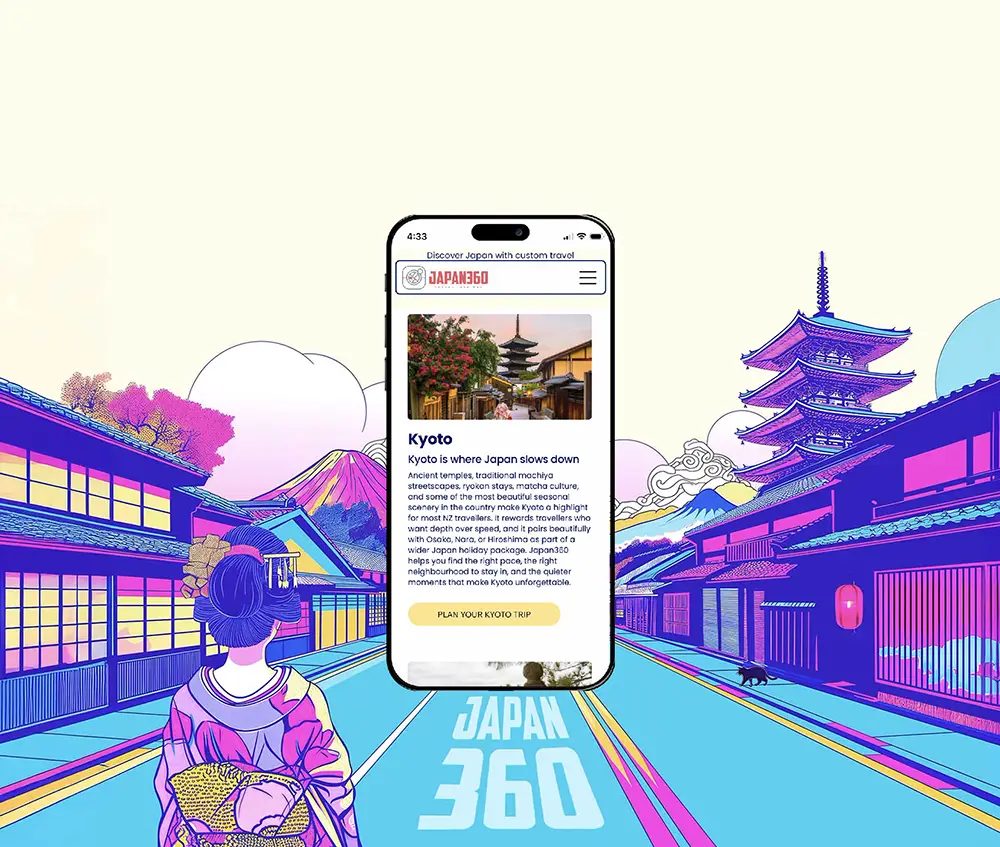
From zero AI citations to cited in Google's AI answers on its specialist terms · AI-referred visitors enquire at 12.5%, three times the rate of organic search.
Pacific Cycle Tours, South Island cycle tours

Pacific Cycle Tours, South Island cycle tours

AI recommendation rate from 40% to 90% at launch, on a 22-question check across five AI tools · Google AI answer placements from 14 to 20 tracked searches across four countries · AI visitors average 5 minutes 24 seconds on site, against about two minutes site-wide.

Every number is the client's own, measured in their accounts. We never promise rankings, citations or recommendations. We promise measurement and honesty.

Kyttn

Let's talk.

By submitting, you agree to our Terms and Privacy Policy.

© 2026 Kyttn

The next time someone asks, be the answer.

Your buyers are already asking. The only question is whose name comes back. The first conversation is free.

No obligation. No pitch deck. Just a clear read on where you actually stand.

Kyttn

Let's talk.

By submitting, you agree to our Terms and Privacy Policy.

© 2026 Kyttn

The next time someone asks, be the answer.

Your buyers are already asking. The only question is whose name comes back. The first conversation is free.

No obligation. No pitch deck. Just a clear read on where you actually stand.

FAQ.

FAQ.

Common questions about AI Visibility.

What is AI visibility?
icon

AI visibility is how often, and how favourably, AI assistants like ChatGPT, Gemini, Copilot and Google's AI answers mention or recommend your business when people ask the questions you should be the answer to. It is measurable: you can test your market's buyer questions against the engines and count who gets named.

What is answer engine optimisation (AEO)?
icon

AEO is the work of making your business the answer AI engines give: structuring pages to answer buyer questions directly, building the reviews, lists and citations the engines draw on, and keeping your business information consistent everywhere they read. The name is new. The discipline is evidence-building.

What is the difference between AEO, GEO and AI SEO?
icon

Mostly vocabulary. AEO (answer engine optimisation), GEO (generative engine optimisation), AI SEO and LLM SEO all describe the same discipline: earning a place in AI-generated answers. The names will consolidate over time. The work is identical.

How do AI assistants choose which businesses to recommend?
icon

They assemble answers from retrievable evidence: pages that directly answer the question, review volume and recency, presence on curated lists and directories, consistent business details across the web, and a distinctive reason to name you. Businesses strong on those signals get recommended. Generic ones get skipped.

Is AI visibility separate from SEO?
icon

No. It is the same foundation with a second audience. AI engines build answers from pages they can crawl, understand and trust, so a business invisible to Google is usually invisible to AI. The two are run as one job: rankings and citations together.

Can you pay to appear in AI recommendations?
icon

The answer itself is earned. Advertising is starting to appear around AI tools, but the name an assistant volunteers is built from evidence, not bought, which is why it carries more trust than an ad and why the visitors it sends convert so well.

How long does AI visibility take to build?
icon

Faster than classic SEO, in our experience, because AI answers refresh from current sources: structural fixes and new answer pages can show up within weeks, and one client went from being recommended on 40% of test questions to 90% at launch. The durable layer, reviews, lists and citations, compounds over months.

How much does AI visibility cost?
icon

It starts with knowing where you stand. The Sphynx 2.0 diagnostic maps your market's buyer questions and who the AI engines currently name, alongside your search position, for NZD $489: about a week, a 60 to 90 minute walkthrough, and a prioritised plan that is yours to keep. If a larger engagement follows, the $489 comes off the first invoice.

Can a new or small business really compete in AI search?
icon

Yes, and often faster than in classic search. AI answers are assembled per question from current evidence, not from years of accumulated domain authority, so a small business that directly answers the questions its buyers ask, with reviews and consistent details behind it, can out-answer a bigger competitor that publishes nothing. One of our clients went from being recommended on 40% of buyer questions to 90% at launch.

Why does my brand matter for AI visibility?
icon

Because a recommendation is a name plus a reason. The engines volunteer businesses they can retrieve with confidence, and retrieval is built on a distinctive, consistently expressed identity: what you do, who for, and why you instead of the next option, said the same way everywhere. The stronger and more consistent the brand, the more often the name comes back.

Which AI platforms does this cover?
icon

The work targets the evidence layer all of them read, so it covers ChatGPT, Google's AI answers and Gemini, Copilot, Perplexity and Claude together. The engines differ in emphasis but assemble answers from the same public signals: answer-shaped pages, reviews, lists, citations and consistent business data. Build the evidence once and every engine reads it.