Website design, built on what people actually search.

Website design, built on what people actually search.

Website design, built on what people actually search.

You have built something real. A website should make it easier to find, not prettier to miss. We design once, against measured demand, with the brand, the search visibility, the AI answers and the advertising all speaking the same language from day one.

You have built something real. A website should make it easier to find, not prettier to miss. We design once, against measured demand, with the brand, the search visibility, the AI answers and the advertising all speaking the same language from day one.

You have built something real. A website should make it easier to find, not prettier to miss. We design once, against measured demand, with the brand, the search visibility, the AI answers and the advertising all speaking the same language from day one.

The problem.

The problem.

Why most websites get designed twice

Why most websites get designed twice

Most websites get paid for twice. Some three times.

Once for the design, when it launches looking sharp and the enquiries stay quiet. Again when someone discovers the searches that matter were never built into it, and the fix is a rebuild. A third time when the ads finally switch on and the pages were never structured to convert a paid click.

None of that is a design problem. It is a sequencing problem. The look was chosen before anyone measured what the market was searching for, so the site was decorating a guess.

We do it in the other order. Demand first, verified against real search data. Then the brand, the pages, the measurement and the advertising are designed around what your customers are already typing, in one build, speaking one language.

Do it once. Do it right. Meet the demand, because creating demand is the expensive way round.

How we know.

How we know.

Sphynx 2.0 before a pixel moves.

Every build starts with Sphynx 2.0, our competitive intelligence diagnostic. Before anything is designed, we map what your market actually searches, which competitors hold which terms, where AI assistants are sending your buyers, and where the gap sits that your business can genuinely take.


That map decides the pages. Each one is built to answer one real search, so the site becomes a set of doors your customers walk through, not a brochure they have to find first. It decided 46 pages for a South Island tour operator and it found an uncontested luxury position for an Auckland salon. Different businesses, same method: measure first, design second.


And because we know your search demand and you know what a customer is worth, the arithmetic is simple. We publish projections before the build and score the actuals against them every month. You see whether the investment is working, early, in numbers you can read.

Most businesses build brand first. Logo, website, photography, brand guide, before they know what the market is actually searching for or who they are actually competing against.

Kyttn builds brand in phase three. After the Sphynx 2.0 diagnostic has identified the gap. After the keyword targets have been validated against real NZ search data. The brand layer is built in phase three alongside the site, which means every creative decision is grounded in the evidence phases one and two produced, rather than gut feel or preference.

If you already have a strong brand, we inject it. We make sure it is working as hard as the performance foundation underneath it. If the brand has not been developed yet, we build it here, based on what the data says the market is ready to respond to.

Either way, brand in phase three is not decoration. It is the thing that takes a technically sound site and turns it into something people trust enough to act on.

Pacific Cycle Tours Web design by Kyttn on tablet and mobile

Bring it to life.

Bring it to life.

What a Kyttn build includes

What a Kyttn build includes

01.

The demand map.

Sphynx 2.0 finds what your market searches in Google and asks the AI assistants, verified against real volume data, sized against your customer value. This is the blueprint everything else follows.

02.

Brand, voice and messaging, one language.

A deep dive into how your business should look and sound, built to fit the gap the data found. Colour, type, photography direction and a written voice that reads like you on your best day, then flows through every page, every ad and every answer. This is where twenty years of creative direction earns its keep: AI assistants cite brands with a point of view and skim past generic copy without a mention. Sounding like everyone else is now a visibility problem, not just a taste problem.

03.

One page per search.

The architecture in five words. Every page is purpose-built for a search your buyers actually make, structured so Google can rank it and AI assistants can quote it: clear answers up front, the right schema underneath, your proof where the right searcher will look for it.

04.

Measurement, wired end to end.

Every form tracked, every call counted, analytics reconciled against your own records so each enquiry is real and each booking attributable. You watch people find you, and you see exactly where they hesitate. No guessing, no vanity charts.

05.

Built ads-ready.

Google Ads only convert on pages built to receive them, so we design the landing paths, the message match and the conversion tracking into the site itself. If there is a paid opportunity in your market, the site is ready for it on day one, and if there is not, we will say so and save you the spend.

06.

Launch without drama, and you own everything.

Redirects engineered so the rankings you have already earned carry across. Launch in a morning, nothing breaks. Then everything is handed back: your site, your accounts, your data. We hold access, never hostage.

Dark gradiend background

What a build produces

What a build produces

Pacific Cycle Tours, remote delivery

Pacific Cycle Tours, remote delivery

Three decades of touring heritage, a perfect five-star rating, and thousands of travellers already searching for exactly this, finding someone else first. Sphynx 2.0 measured the demand, the build shipped 46 pages to meet it, industry-leading tracking went in so every enquiry gets seen, and launch took one morning with the ranking history carried across.

Month one: 18 enquiries against a plan that targeted 17 to 18 by month twelve. Half of the website enquirers went on to book. The Australian money searches moved from page two to page one. And the client now spends 25 dollars a day less than before we arrived, because we moved the budget from creating demand to capturing it, and handed the difference back.

$

0-18

0-18

measurable enquiries in month one after launch

measurable enquiries in month one after launch

#1

#1

Page 2 → 1 on every Australian money search

Page 2 → 1 on every Australian money search

90%

90%

 AI answer visibility from 40%

 AI answer visibility from 40%

81%

organic sessions up in the first 28 days

50%

50%

of website enquirers went on to book

In their words.

In their words.

"From the moment our new website launched, the proof was in the enquiries. More quality hits, more enquiries that converted to bookings, and it felt like the increase was almost immediate."

What a build produces

What a build produces

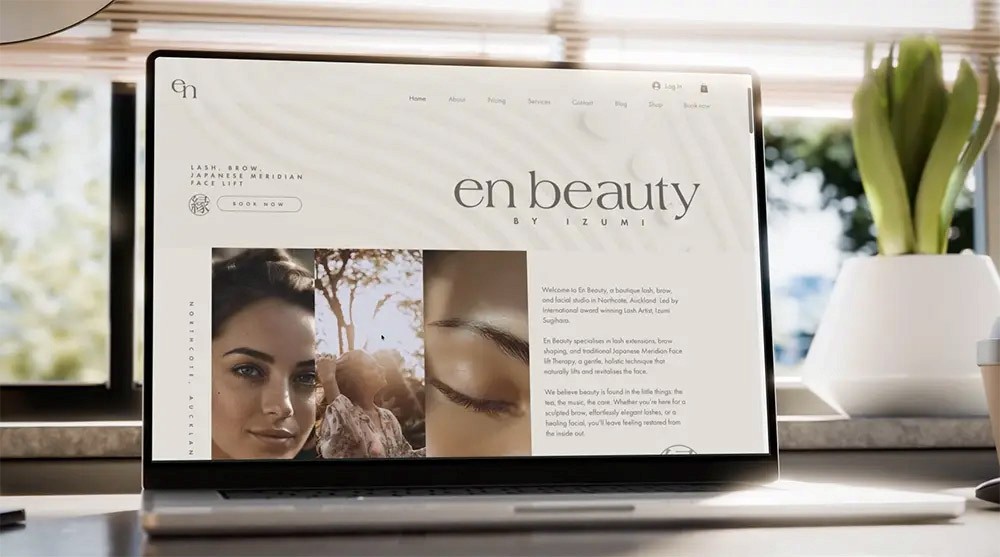
En Beauty, Auckland

En Beauty, Auckland

A brand designed into a gap Sphynx 2.0 found: a luxury position sitting wide open while the category raced to the bottom on price. One salon, built once, with the brand, the search visibility and the advertising in sync from day one.

Today it signs two new clients a day, more than 550 since launch, converts at 6 percent against a 2 percent industry average, and ranks first in AI visibility across every Auckland beauty competitor. The founder is building bigger premises and hiring to keep up. En Beauty is a Kyttn venture, our own money on our own method, which is exactly why it runs first in the proof.

$

2

2

New clients a day on average for one salon

New clients a day on average for one salon

550+

550+

New clients since launch and counting

New clients since launch and counting

#1

#1

In AI visibility

In AI visibility

81%

organic sessions up in the first 28 days

6%

6%

Customer conversion vs a 2% industry average

In their words.

In their words.

"They took my vision and elevated it into a stunning, high-converting digital brand. Their design work is not just beautiful, it is intuitive and perfectly captures the aesthetic of my studio."

Izumi Sugihara, Founder, En Beauty

Let's go.

Let's go.

Make it happen.

Starting a business is one of the biggest swings most people ever take. Nothing is worse than watching a good one stay invisible, a real product, real skill, real care, and a website that never brings anyone to the door.


That is the job. Not decoration. Take the thing you have built and give it the best possible chance of being found, chosen and booked, then prove it with numbers you can read every month.


You made the business. We make it findable.

Most businesses build brand first. Logo, website, photography, brand guide, before they know what the market is actually searching for or who they are actually competing against.

Kyttn builds brand in phase three. After the Sphynx 2.0 diagnostic has identified the gap. After the keyword targets have been validated against real NZ search data. The brand layer is built in phase three alongside the site, which means every creative decision is grounded in the evidence phases one and two produced, rather than gut feel or preference.

If you already have a strong brand, we inject it. We make sure it is working as hard as the performance foundation underneath it. If the brand has not been developed yet, we build it here, based on what the data says the market is ready to respond to.

Either way, brand in phase three is not decoration. It is the thing that takes a technically sound site and turns it into something people trust enough to act on.

Make it work.

Make it work.

Who this is for.

Businesses with something real to build on. You have launched and the website has not kept up with the work, or you are a new brand that needs to know where to point before you spend a dollar building. Either way, the method is the same: find the demand, design into it, measure everything.


It is not for template shopping, logo-only jobs, or the cheapest quote in the inbox. If price is the only question, we are the wrong answer.

Most businesses build brand first. Logo, website, photography, brand guide, before they know what the market is actually searching for or who they are actually competing against.

Kyttn builds brand in phase three. After the Sphynx 2.0 diagnostic has identified the gap. After the keyword targets have been validated against real NZ search data. The brand layer is built in phase three alongside the site, which means every creative decision is grounded in the evidence phases one and two produced, rather than gut feel or preference.

If you already have a strong brand, we inject it. We make sure it is working as hard as the performance foundation underneath it. If the brand has not been developed yet, we build it here, based on what the data says the market is ready to respond to.

Either way, brand in phase three is not decoration. It is the thing that takes a technically sound site and turns it into something people trust enough to act on.

Kyttn

Let's talk.

By submitting, you agree to our Terms and Privacy Policy.

© 2026 Kyttn

Start with a conversation.

The first conversation is free. If there is a real opportunity, we run Sphynx 2.0 on your market: NZD $489, about a week, and you keep the findings either way. You will know what your buyers search, who really holds your market, and what your website needs to be, before you commit to building anything. If a build follows, the $489 comes off the first invoice.

No obligation. No pitch deck. Just a clear conversation.

Kyttn

Let's talk.

By submitting, you agree to our Terms and Privacy Policy.

© 2026 Kyttn

Start with a conversation.

The first conversation is free. If there is a real opportunity, we run Sphynx 2.0 on your market: NZD $489, about a week, and you keep the findings either way. You will know what your buyers search, who really holds your market, and what your website needs to be, before you commit to building anything. If a build follows, the $489 comes off the first invoice.

No obligation. No pitch deck. Just a clear conversation.

Kyttn

Let's talk.

By submitting, you agree to our Terms and Privacy Policy.

Start with a conversation.

The first conversation is free. If there is a real opportunity, we run Sphynx 2.0 on your market: NZD $489, about a week, and you keep the findings either way. You will know what your buyers search, who really holds your market, and what your website needs to be, before you commit to building anything. If a build follows, the $489 comes off the first invoice.

No obligation. No pitch deck. Just a clear conversation.

FAQ.

FAQ.

Common questions about website design in NZ & Australia.

How much does website design cost in NZ and Australia?
icon

Across the NZ and Australian market, template and DIY builds run from a few hundred dollars to around $3,000, small studio builds typically land between $3,000 and $10,000, and a full build with the marketing engine included, brand, SEO and AI visibility architecture, measurement and advertising, generally sits from $10,000 upward. The real question is which searches the site is built to win, because a cheap site nobody finds costs more than any of these. We publish a full market guide at kyttn.co.nz/costs, and every Kyttn build is scoped after the $489 Sphynx 2.0 diagnostic so the price fits what your market actually requires.

How long does a website build take?
icon

A typical Kyttn build runs four to eight weeks from diagnostic to launch, in fixed stages with every approval in writing. Launch itself takes one morning, with redirects engineered so existing rankings carry across and nothing breaks.

Do you only work in Auckland?
icon

No. Kyttn is based in Auckland and works with businesses across New Zealand and Australia, almost always remotely. Two of our current builds, a South Island tour operator and a nationwide travel specialist, have run entirely remote from first call to launch.

Will a rebuild lose the Google rankings we already have?
icon

Not if the redirects are engineered properly. On our most recent rebuild, three years of ranking equity carried through a full redesign and domain change with zero downtime, and the money searches moved from page two to page one within the first month. We never promise rankings, we build the architecture and measure the result in the open.

What does designing for demand actually mean?
icon

It means the search data comes before the design. Sphynx 2.0 maps what your market types into Google and asks AI assistants, then every page, the brand voice and the ad structure are designed to answer those exact searches. The alternative is designing to taste and hoping the demand shows up, which is how websites end up being paid for twice.

How much does website design cost in NZ and Australia?
icon

Across the NZ and Australian market, template and DIY builds run from a few hundred dollars to around $3,000, small studio builds typically land between $3,000 and $10,000, and a full build with the marketing engine included, brand, SEO and AI visibility architecture, measurement and advertising, generally sits from $10,000 upward. The real question is which searches the site is built to win, because a cheap site nobody finds costs more than any of these. We publish a full market guide at kyttn.co.nz/costs, and every Kyttn build is scoped after the $489 Sphynx 2.0 diagnostic so the price fits what your market actually requires.

How long does a website build take?
icon

A typical Kyttn build runs four to eight weeks from diagnostic to launch, in fixed stages with every approval in writing. Launch itself takes one morning, with redirects engineered so existing rankings carry across and nothing breaks.

Do you only work in Auckland?
icon

No. Kyttn is based in Auckland and works with businesses across New Zealand and Australia, almost always remotely. Two of our current builds, a South Island tour operator and a nationwide travel specialist, have run entirely remote from first call to launch.

Will a rebuild lose the Google rankings we already have?
icon

Not if the redirects are engineered properly. On our most recent rebuild, three years of ranking equity carried through a full redesign and domain change with zero downtime, and the money searches moved from page two to page one within the first month. We never promise rankings, we build the architecture and measure the result in the open.

What does designing for demand actually mean?
icon

It means the search data comes before the design. Sphynx 2.0 maps what your market types into Google and asks AI assistants, then every page, the brand voice and the ad structure are designed to answer those exact searches. The alternative is designing to taste and hoping the demand shows up, which is how websites end up being paid for twice.

How much does website design cost in NZ and Australia?
icon

Across the NZ and Australian market, template and DIY builds run from a few hundred dollars to around $3,000, small studio builds typically land between $3,000 and $10,000, and a full build with the marketing engine included, brand, SEO and AI visibility architecture, measurement and advertising, generally sits from $10,000 upward. The real question is which searches the site is built to win, because a cheap site nobody finds costs more than any of these. We publish a full market guide at kyttn.co.nz/costs, and every Kyttn build is scoped after the $489 Sphynx 2.0 diagnostic so the price fits what your market actually requires.

How long does a website build take?
icon

A typical Kyttn build runs four to eight weeks from diagnostic to launch, in fixed stages with every approval in writing. Launch itself takes one morning, with redirects engineered so existing rankings carry across and nothing breaks.

Do you only work in Auckland?
icon

No. Kyttn is based in Auckland and works with businesses across New Zealand and Australia, almost always remotely. Two of our current builds, a South Island tour operator and a nationwide travel specialist, have run entirely remote from first call to launch.

Will a rebuild lose the Google rankings we already have?
icon

Not if the redirects are engineered properly. On our most recent rebuild, three years of ranking equity carried through a full redesign and domain change with zero downtime, and the money searches moved from page two to page one within the first month. We never promise rankings, we build the architecture and measure the result in the open.

What does designing for demand actually mean?
icon

It means the search data comes before the design. Sphynx 2.0 maps what your market types into Google and asks AI assistants, then every page, the brand voice and the ad structure are designed to answer those exact searches. The alternative is designing to taste and hoping the demand shows up, which is how websites end up being paid for twice.