How much does a website cost in NZ and Australia?
How much does a website cost in NZ and Australia?
How much does a website cost in NZ and Australia?
The straight answer: anywhere from a few hundred dollars to fifty thousand or more, and the number on the quote is the least useful thing about it. What matters is what the money buys, because the most expensive website in the country is the cheap one nobody ever finds.
The straight answer: anywhere from a few hundred dollars to fifty thousand or more, and the number on the quote is the least useful thing about it. What matters is what the money buys, because the most expensive website in the country is the cheap one nobody ever finds.
The straight answer: anywhere from a few hundred dollars to fifty thousand or more, and the number on the quote is the least useful thing about it. What matters is what the money buys, because the most expensive website in the country is the cheap one nobody ever finds.
The guide.
The guide.
This page is the guide we wish every business owner read before paying for a website.
This page is the guide we wish every business owner read before paying for a website.
Market rates as they actually run across New Zealand and Australia, what each band includes and quietly leaves out, and the questions that protect you with any provider, including us.


Prices in NZ and Aus.
Prices in NZ and Aus.
The market, in bands
The market, in bands
01.
Under $3,000 · templates and DIY
Website builders, templates, marketplace freelancers. You get pages on the internet, often quickly, and that is genuinely enough for some businesses. What is almost never included: any research into what your market searches, any structure a search engine or AI assistant can favour, or any measurement that tells you whether the site produces a single enquiry. This band is where the paid-for-twice cycle usually starts.
02.
$3,000 to $10,000 · small studio builds
A designed site, usually on WordPress, Wix, Squarespace or Framer, with a professional look and basic search hygiene. The look is often good. The gap is usually underneath: keyword research thin or skipped, pages organised around the company menu rather than what customers search, tracking limited to a visits counter, and nothing built for the AI answers a growing share of buyers now read instead of the results page.
03.
$10,000 to $30,000+ · the full build
A site designed from demand data: research into what your market actually searches, one page per search, a brand and voice applied consistently, structured content that AI assistants can cite, measurement wired to every form and call, and landing paths built so advertising converts from day one. This is the band where a website stops being a brochure and becomes the engine of the marketing. It is where Kyttn builds sit, scoped to what the diagnostic finds rather than a package.
04.
Beyond · enterprise and e-commerce at scale
Custom platforms, large catalogues, integrations. Different game, different guide.

The watchout.
The watchout.
Why cheap gets paid for twice.
Here is the pattern we keep meeting in diagnostics. A business pays for a website that launches looking fine. A year later nobody has arrived through it, so someone quotes an SEO retrofit, which mostly means rebuilding pages that were never aimed at a real search. Later the ads switch on and the pages were never built to convert a paid click, so that gets rebuilt too.
Three invoices for one website. The maths of doing it once: the searches your market makes are measurable before you spend, and once you know your demand and what a customer is worth to you, working out whether a build pays for itself is simple arithmetic. That is why every Kyttn engagement starts with the measurement, not the mockups, and why we publish projections and score the actuals against them every month once a build is live.
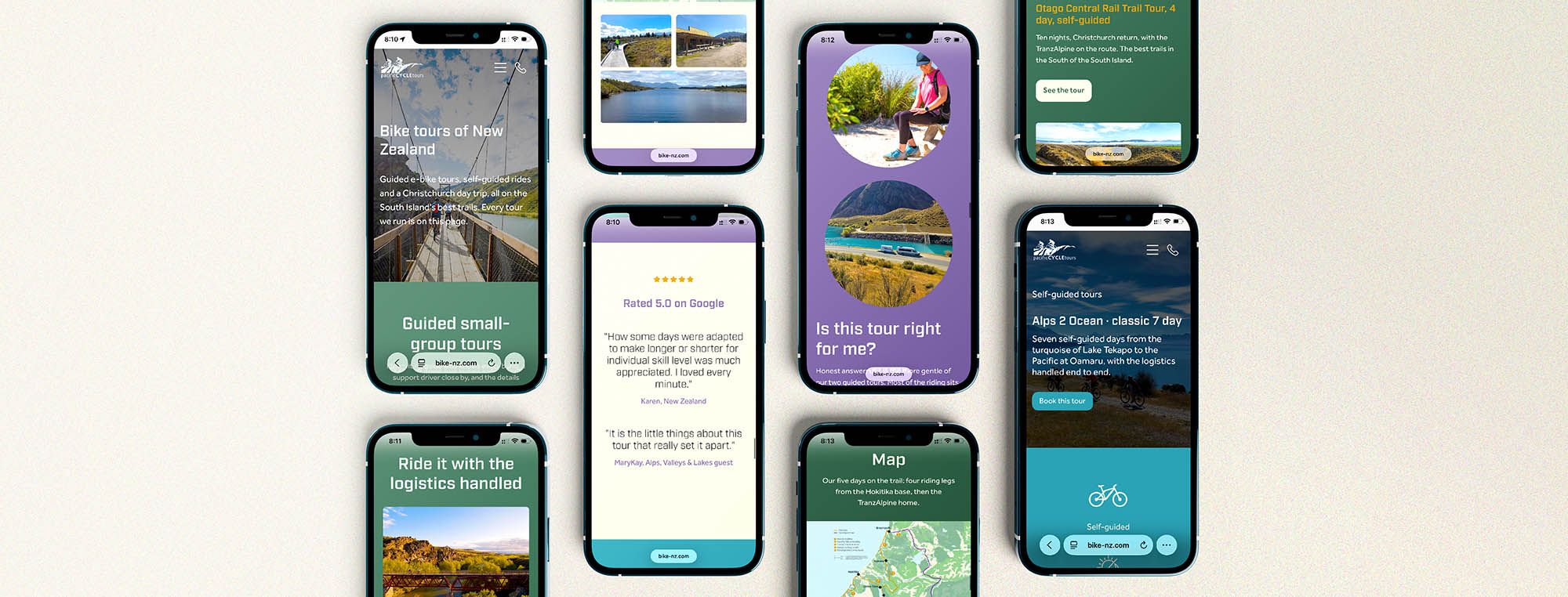
One recent example of the arithmetic working: a tour operator whose rebuilt site produced 18 measured enquiries in its first month, against a plan that targeted that number by month twelve, with half of those enquirers going on to book.
Most businesses build brand first. Logo, website, photography, brand guide, before they know what the market is actually searching for or who they are actually competing against.
Kyttn builds brand in phase three. After the Sphynx 2.0 diagnostic has identified the gap. After the keyword targets have been validated against real NZ search data. The brand layer is built in phase three alongside the site, which means every creative decision is grounded in the evidence phases one and two produced, rather than gut feel or preference.
If you already have a strong brand, we inject it. We make sure it is working as hard as the performance foundation underneath it. If the brand has not been developed yet, we build it here, based on what the data says the market is ready to respond to.
Either way, brand in phase three is not decoration. It is the thing that takes a technically sound site and turns it into something people trust enough to act on.
Questions.
Questions.
What to ask for before you pay.
Which exact searches will this site be built to win, and what data says people make them?
How will the site appear in AI answers, ChatGPT, Gemini and Google's AI Overviews, not just the blue links?
What gets measured, and will every enquiry and phone call be counted from day one?
If we run Google Ads later, are the landing pages and conversion tracking already built for it?
If we already rank for anything, how do the redirects protect it through the rebuild?
Who owns the site, the accounts and the data when we are done? The only right answer is you.
What happens in month two? A website is a launch, marketing is a habit.
Most businesses build brand first. Logo, website, photography, brand guide, before they know what the market is actually searching for or who they are actually competing against.
Kyttn builds brand in phase three. After the Sphynx 2.0 diagnostic has identified the gap. After the keyword targets have been validated against real NZ search data. The brand layer is built in phase three alongside the site, which means every creative decision is grounded in the evidence phases one and two produced, rather than gut feel or preference.
If you already have a strong brand, we inject it. We make sure it is working as hard as the performance foundation underneath it. If the brand has not been developed yet, we build it here, based on what the data says the market is ready to respond to.
Either way, brand in phase three is not decoration. It is the thing that takes a technically sound site and turns it into something people trust enough to act on.
© 2026 Kyttn
Where Kyttn fits, and our only public number
We do not publish a rate card, because the honest price depends on what your market requires, and we do not know that until we have measured it. What we publish is the first step: the Sphynx 2.0 diagnostic, NZD $489, about a week, a full map of your demand, your real competitors and what your website needs to be. Yours to keep either way, and it comes off the first invoice if a build follows. After the diagnostic you get a fixed, staged quote, projections included, and you will know before you spend whether the arithmetic works. If it does not, we will be the ones who tell you.
No obligation. No pitch deck. Just a clear conversation.

Where Kyttn fits, and our only public number
We do not publish a rate card, because the honest price depends on what your market requires, and we do not know that until we have measured it. What we publish is the first step: the Sphynx 2.0 diagnostic, NZD $489, about a week, a full map of your demand, your real competitors and what your website needs to be. Yours to keep either way, and it comes off the first invoice if a build follows. After the diagnostic you get a fixed, staged quote, projections included, and you will know before you spend whether the arithmetic works. If it does not, we will be the ones who tell you.
No obligation. No pitch deck. Just a clear conversation.
© 2026 Kyttn
Where Kyttn fits, and our only public number
We do not publish a rate card, because the honest price depends on what your market requires, and we do not know that until we have measured it. What we publish is the first step: the Sphynx 2.0 diagnostic, NZD $489, about a week, a full map of your demand, your real competitors and what your website needs to be. Yours to keep either way, and it comes off the first invoice if a build follows. After the diagnostic you get a fixed, staged quote, projections included, and you will know before you spend whether the arithmetic works. If it does not, we will be the ones who tell you.
No obligation. No pitch deck. Just a clear conversation.
FAQ.
FAQ.
Common questions about website costs.

Template and DIY builds run under $3,000, small studio builds typically cost $3,000 to $10,000, and a full build with search, AI visibility, measurement and advertising designed in generally runs $10,000 to $30,000 or more. Prices run similarly in Australia. The band matters less than whether the site is built on measured demand, because a site nobody finds is the most expensive kind at any price.
Because website is one word covering three different products: pages that exist, pages that look professional, and pages engineered to be found, cited by AI and to convert. Most of the price difference sits in the invisible layer, research, architecture, structured data and measurement, which is also the layer that produces enquiries.
Sometimes, honestly. If your work all arrives by referral and the site only needs to confirm you exist, a simple build can be enough. The trap is paying cheap-site money while expecting found-site results, that is how the same website gets bought twice.
Hosting and a domain run a few hundred dollars a year. The real ongoing cost is keeping the marketing working, content, search, AI visibility and advertising, which most businesses handle with an in-house hire, a set of vendors, or an outsourced arrangement scoped to their size. Whatever the model, insist on monthly reporting that shows actuals against a plan.
Two numbers: the measurable search demand in your market, and what a customer is worth to you. Multiply honestly and compare with the quote. A proper diagnostic gives you the first number before you commit to anything, which is exactly what Sphynx 2.0 is for.
Template and DIY builds run under $3,000, small studio builds typically cost $3,000 to $10,000, and a full build with search, AI visibility, measurement and advertising designed in generally runs $10,000 to $30,000 or more. Prices run similarly in Australia. The band matters less than whether the site is built on measured demand, because a site nobody finds is the most expensive kind at any price.
Because website is one word covering three different products: pages that exist, pages that look professional, and pages engineered to be found, cited by AI and to convert. Most of the price difference sits in the invisible layer, research, architecture, structured data and measurement, which is also the layer that produces enquiries.
Sometimes, honestly. If your work all arrives by referral and the site only needs to confirm you exist, a simple build can be enough. The trap is paying cheap-site money while expecting found-site results, that is how the same website gets bought twice.
Hosting and a domain run a few hundred dollars a year. The real ongoing cost is keeping the marketing working, content, search, AI visibility and advertising, which most businesses handle with an in-house hire, a set of vendors, or an outsourced arrangement scoped to their size. Whatever the model, insist on monthly reporting that shows actuals against a plan.
Two numbers: the measurable search demand in your market, and what a customer is worth to you. Multiply honestly and compare with the quote. A proper diagnostic gives you the first number before you commit to anything, which is exactly what Sphynx 2.0 is for.
Template and DIY builds run under $3,000, small studio builds typically cost $3,000 to $10,000, and a full build with search, AI visibility, measurement and advertising designed in generally runs $10,000 to $30,000 or more. Prices run similarly in Australia. The band matters less than whether the site is built on measured demand, because a site nobody finds is the most expensive kind at any price.
Because website is one word covering three different products: pages that exist, pages that look professional, and pages engineered to be found, cited by AI and to convert. Most of the price difference sits in the invisible layer, research, architecture, structured data and measurement, which is also the layer that produces enquiries.
Sometimes, honestly. If your work all arrives by referral and the site only needs to confirm you exist, a simple build can be enough. The trap is paying cheap-site money while expecting found-site results, that is how the same website gets bought twice.
Hosting and a domain run a few hundred dollars a year. The real ongoing cost is keeping the marketing working, content, search, AI visibility and advertising, which most businesses handle with an in-house hire, a set of vendors, or an outsourced arrangement scoped to their size. Whatever the model, insist on monthly reporting that shows actuals against a plan.
Two numbers: the measurable search demand in your market, and what a customer is worth to you. Multiply honestly and compare with the quote. A proper diagnostic gives you the first number before you commit to anything, which is exactly what Sphynx 2.0 is for.